
In short
AI-native consulting firms have the edge when speed, a small senior team and a result that keeps working after the project matter most. In the Harvard and BCG field experiment, consultants using AI completed 12.2% more tasks and worked 25.1% faster; on a task outside what the AI could do, they were 19 percentage points less likely to be correct. The winner combines AI drafting with experienced judgment. Traditional large firms keep the edge on programmes with hundreds of people across many countries, on benchmarks from thousands of projects, and on audit and assurance.
Key takeaways
- AI-native means the way of working, the team and the deliverable are built around AI. Agents draft; experienced consultants check and decide.
- AI-native firms win on speed, seniority in the team, results that stay, and price for well-defined questions.
- Traditional large firms win on global programmes, benchmarks from many engagements, and audit with an opinion.
- The large firms are rebuilding: starting salaries frozen for a third year, fewer graduates, about a quarter of McKinsey's fees tied to outcomes.
- AI labs such as Anthropic and OpenAI are buying exactly these small teams, not pyramids.
Almost every consulting firm uses AI today. The difference is whether the operating model is built around it: who does the work, what you get at the end, and what you pay for. This comparison takes the client's view: where AI-native consultancies have the edge, where traditional large firms stay ahead, and how to tell them apart in a first meeting. LEADBeyond is itself an AI-native boutique; our own details are collected at the end.
Definition
AI-native consulting firm (AI-first consultancy) is a consulting firm whose way of working, team shape and deliverables are designed around AI from the start. AI agents produce research, drafts, financial models and code; experienced consultants check, decide and put their name to the result. The deliverable is often a tool that keeps working at the client, not just a slide deck. The counterpart is the traditional firm with a pyramid of many juniors and few partners, billed mostly by day rates.
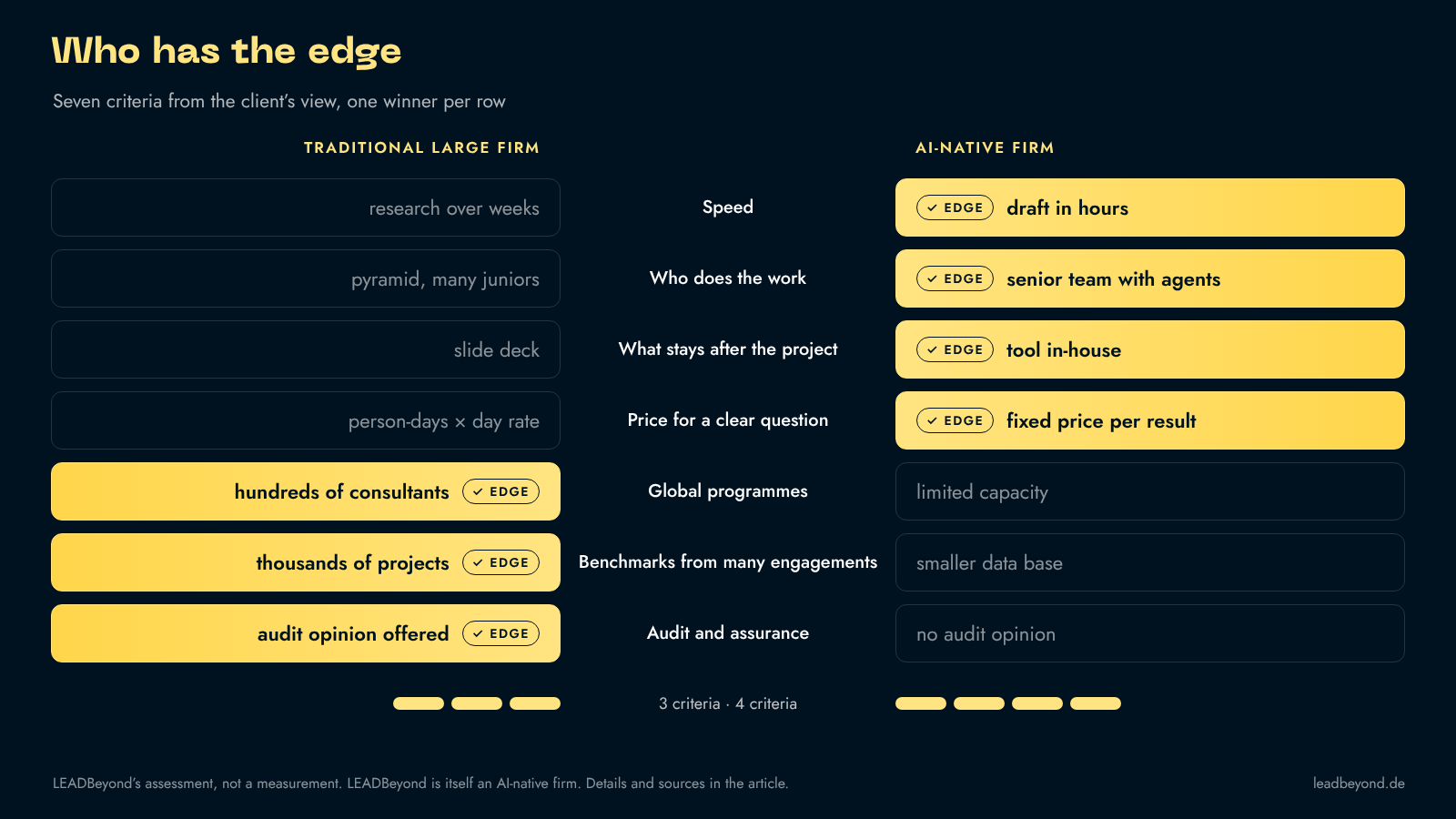
The comparison: seven criteria, one clear winner per row
The table compares typical firms of both kinds. Individual firms differ, which is why the five questions further down are worth asking.
| Criterion | Traditional large firm | AI-native firm | Edge |
|---|---|---|---|
| Time to a first robust answer | Research, analysis and slides are built by a team over weeks. | Agents deliver drafts in hours; experienced consultants check and decide. | AI-native |
| Who does the work | Pyramid: much of the work sits with juniors, partners steer several projects. | Small senior team; agents take the drafting and routine work. | AI-native |
| What stays after the project | Usually a recommendation and a deck; building often happens later, with another vendor. | Often a tool: a financial model or AI application that keeps working in-house. | AI-native |
| Price for a well-defined question | Mostly person-days times day rate; outcome-based fees are growing (McKinsey: about a quarter). | Fewer person-days in the proposal; a fixed price per result is easier to carry. | AI-native |
| Large programmes across many countries | Hundreds of consultants, offices worldwide, proven programme management. | Limited capacity; scales through tools, not headcount. | Traditional |
| Benchmarks from many engagements | Benchmarks and knowledge bases from thousands of projects. | Smaller own data base; works with public sources, expert interviews and your data. | Traditional |
| Audit and assurance | Audit with an opinion from one firm. | No audit opinion on offer. | Traditional |
The upshot: for a well-defined question that needs a decision within weeks, for a tool that should stay in-house, and for most mid-sized company projects, the AI-native firm is the better choice. For a global programme with hundreds of people, or an audit with an opinion, the large firm stays ahead.
Why AI-native consultancies are faster and leaner
The best evidence comes from a field experiment by Harvard Business School with Wharton, MIT and Boston Consulting Group: 758 BCG consultants, 18 realistic consulting tasks. On tasks inside what AI does well, consultants using GPT-4 completed 12.2% more tasks on average, were 25.1% faster and produced significantly higher quality. On a task outside that frontier, they were 19 percentage points less likely to be correct than colleagues without AI.
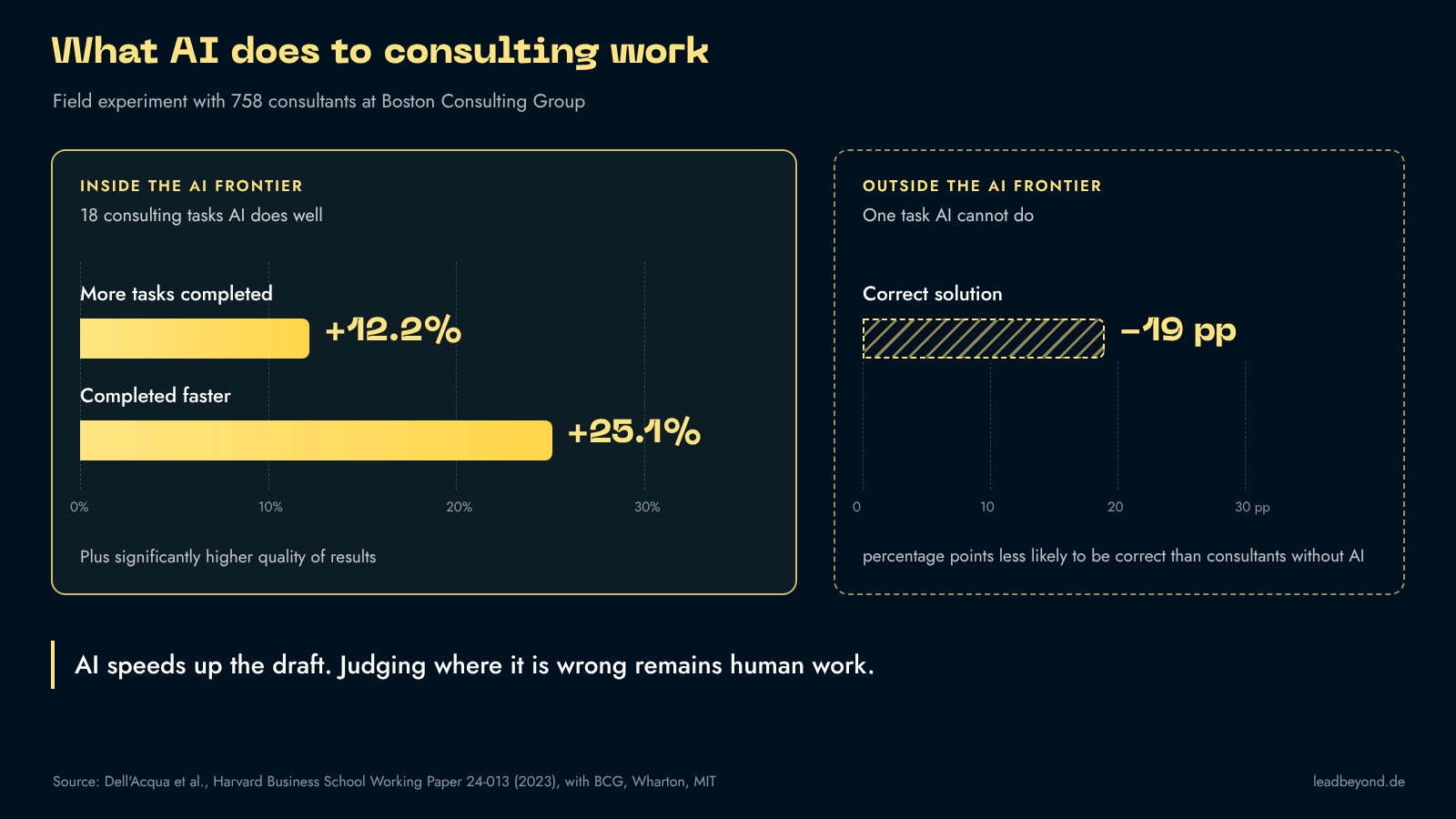
For choosing a firm, this means two things. First, research, drafting and running scenarios get much faster with AI, which saves person-days. Second, you need people who notice where the AI hits its limits. In the experiment, weaker consultants gained most (+43% against their own baseline, stronger ones +17%). AI lifts junior work most; what stays scarce is experienced judgment. That is exactly how an AI-native firm builds its team: a few experienced people who check and decide.
Same task, two ways of working
Three typical tasks compared
-
Market analysis for a growth decision
Traditional large firmA team of analysts reviews sources and builds spreadsheets and slides. The partner sees the result before the steering committee.
- weeks of research
- senior involved late
AI-native firmAgents produce the research and derivations, every number with its source. An experienced consultant checks against the primary source and decides with you.
- every number sourced
- senior from day 1
-
Business case for an investment
Traditional large firmA spreadsheet model with fixed scenarios, handed over as a PDF at the end.
- new question, new project
AI-native firmA financial model with a cockpit: new assumptions at the push of a button, every number derived. It stays with you.
- run scenarios yourself
- stays in-house
-
A process with lots of manual work, e.g. order entry
Traditional large firmTarget process and an implementation recommendation; building happens later, often with another vendor.
- concept without a tool
- second vendor
AI-native firmA controlled MVP in typically two to four weeks: AI prepares, a person approves, the ERP stays in charge.
- tool in operation
- a person approves
What this looks like step by step, and which doubts are fair, is covered in AI-aided strategy consulting. An example from implementation: Vibe tooling: AI order entry.
The large firms are rebuilding
Traditional consultancies are responding, at the base of their pyramid and in how they charge.
- Fewer juniors. Top consulting firms have frozen starting salaries for the third year running, the Financial Times reported. In December 2025, two Big Four executives estimated that graduate recruitment at the UK's largest consulting and accounting firms would fall by about half the following year. McKinsey, by contrast, announced 12% more graduates for 2026.
- Different profiles. PwC US hired fewer consultants and accountants in 2026 than two years earlier, according to its CEO Paul Griggs, and more data scientists and engineers.
- Smaller headcount. Accenture's headcount fell by more than 11,000 to 779,000 in the three months to August 2025.
- Paying for outcomes. About a quarter of McKinsey's global fees are now tied to results, according to the firm (November 2025). At EY, the view is that AI agents may call for a "service-as-a-software" approach: part of the service is delivered by software, with people steering and checking.
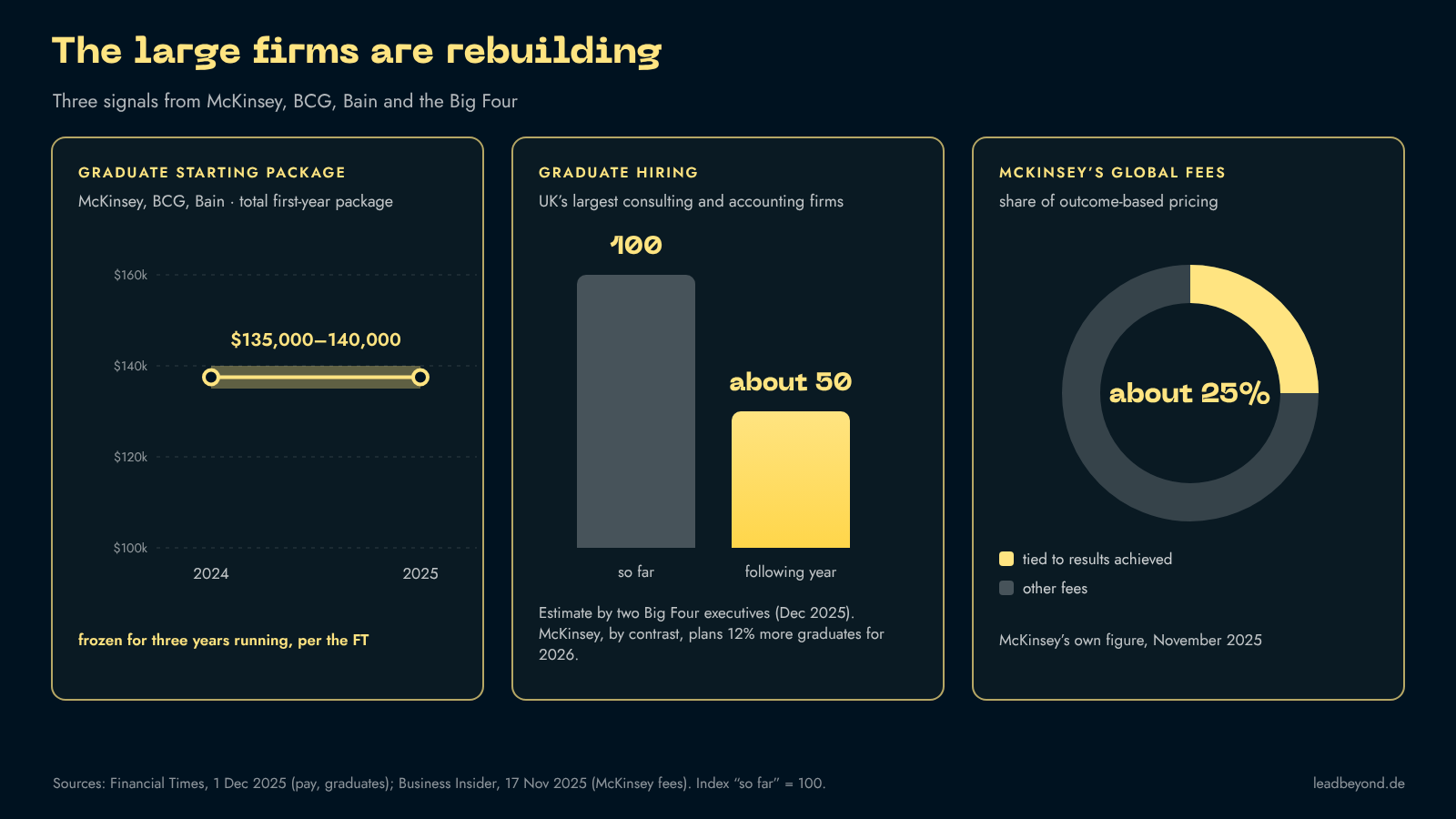
So the large firms also want less manual work and more pay for results. AI-native consultancies start there, without a pyramid to rebuild. What paying for outcomes can look like is covered in The future of consulting.
Where traditional large firms keep the edge
- Large programmes across many countries. When hundreds of people in many countries change at once, capacity counts. A boutique scales through tools, not headcount.
- Benchmarks from many engagements. Large firms have benchmarks from thousands of projects. A small firm works with public sources, expert interviews and your data.
- Audit and assurance. Statutory audits and audit opinions stay with audit firms.
- The name as cover. Sometimes a well-known name is meant to back a decision in front of the board. That is a legitimate reason; it should just be a conscious one.
The two can be combined: the large firm for the global programme, an AI-native boutique for a fast basis for decision or a tool that stays in-house after the project. The kinds of AI consulting available to mid-sized companies are compared in AI consulting for mid-sized companies.
Five questions that reveal an AI-native consulting firm
For the first meeting
Five questions for any firm that calls itself AI-native
- Who does the work?Ask how many hours experienced consultants spend on the project each week, and what agents take over.
- What stays after the project?A tool, a financial model, or only slides? And who owns the code and data afterwards?
- How is work checked?A source for every number, a second look by a person or a second model, sign-off by a named person.
- Which data may go into which tool?The rules are set before the start, not after something goes wrong.
- What do you pay for?Time or results? And who carries the risk if it takes longer?
A firm that answers all five concretely works AI-native. A firm that only names tools uses AI but is not built on it.
Why AI labs and investors buy exactly these firms
The services firm Anthropic set up in May 2026 with Blackstone, Hellman & Friedman and Goldman Sachs (now Ode) acquired the small AI consultancies Fractional AI and Casper Studios. OpenAI is buying London consultancy Tomoro with about 150 forward deployed engineers; the deal is subject to approvals. The buyers are not buying pyramids but small teams with a track record of putting AI into operation. M&A adviser Aventis sums up what buyers want: "a sharp thesis, a credible team, and clients willing to pay for it". Background and timeline: Why Anthropic and OpenAI are buying consulting firms.
Where LEADBeyond stands
LEADBeyond is an AI-aided boutique strategy consultancy from Munich, founded by Frederic C. Rupprecht and Jonathan M. Günak, former partners at McKinsey & Company and Roland Berger. We work the way this comparison describes an AI-native firm: senior-led, no pyramid, with tools that stay.
- Strategy and build in one team. We decide with you where AI pays off and build the tools on your systems. Microsoft, SAP and Salesforce stay in charge. A controlled MVP typically takes two to four weeks.
- Built with AI, checked by people. Our tools are built with an AI coding agent (Claude Code) to a specification, with test cases, review by a second model and human sign-off. See Vibe tooling: AI order entry.
- Our own AI products in daily use. With LEADBeyond 360° (150+ users), ValueScore for performance reviews and bonus in consulting firms, and our own AI chief of staff, we work every day with what we recommend.
- Your code, your choice. Code, data and know-how can go fully to your team. You choose the operating model: handover, continue together, or managed.
Frequently asked questions
What is an AI-native consulting firm?
A consulting firm whose way of working, team and deliverables are designed around AI from the start. AI agents handle research, drafts, financial models and code; experienced consultants check and decide. The result is often a tool that keeps working at the client. AI-first consultancy means the same.
What is the difference between AI-native and traditional consulting?
Traditional firms work with a pyramid of many juniors and few partners and bill mostly by day rates; the deliverable is usually a recommendation. AI-native firms work with small senior teams, let agents do drafting and routine work, and often hand over a tool that stays in-house.
Are AI-native consulting firms cheaper?
For well-defined questions often yes, because fewer person-days are needed. There are no robust market-wide price comparisons yet. Ask for a fixed price per result and who carries the risk if it takes longer.
Will AI replace management consultants?
No, but it changes who does the work and what clients pay for. Large firms are hiring fewer graduates and tying more fees to outcomes. In the Harvard and BCG field experiment, consultants using AI were 19 percentage points less likely to be correct on a task outside the AI frontier, so experienced judgment remains in demand.
When is a traditional large consulting firm the better choice?
For programmes with hundreds of people across many countries, when benchmarks from thousands of projects are decisive, and for audit and assurance. Also when a well-known name is meant to back a decision in front of the board.
How can I tell whether a firm really works AI-native?
From five answers: who does the work, what stays after the project, how work is checked, which data may go into which tool, and what you pay for. A firm that only names tools uses AI but is not built on it.
What does "services as software" mean?
Part of a service is delivered by software: AI agents carry out work steps while people steer, check and take responsibility for the result. EY has said AI agents may call for this approach. For clients it usually means more fixed prices per result and tools that keep running after the project.
Why are AI labs like Anthropic and OpenAI buying consulting firms?
Because they need teams that put AI into operation at clients. Anthropic's services firm Ode acquired Fractional AI and Casper Studios; OpenAI is buying Tomoro with about 150 forward deployed engineers. They look for small teams with a clear thesis and paying clients.
Sources
- Navigating the Jagged Technological Frontier: Field Experimental Evidence of the Effects of AI on Knowledge Worker Productivity and Quality, Harvard Business School (Working Paper 24-013), mit BCG, Wharton, MIT Sloan und Warwick (2023). Dell'Acqua, McFowland, Mollick, Lifshitz-Assaf, Kellogg, Rajendran, Krayer, Candelon, Lakhani, 22 Sep 2023: pre-registered field experiment with 758 BCG consultants; inside the AI frontier 12.2% more tasks, 25.1% faster, significantly higher quality; below-average consultants +43%, above-average +17%; outside the frontier 19 percentage points less likely to be correct; retrieved 19 Nov 2026.
- AI is reshaping how McKinsey makes money, Business Insider (via Yahoo Finance) (2025). Polly Thompson, 17 Nov 2025: about a quarter of McKinsey's global fees come from outcome-based pricing (Michael Birshan, McKinsey); EY (Raj Sharma) says AI agents may call for a "service-as-a-software" approach; retrieved 19 Nov 2026.
- Top consultancies freeze starting salaries as AI threatens 'pyramid' model, Financial Times (via The Irish Times) (2025). Stephen Foley, Ellesheva Kissin, 1 Dec 2025: starting salaries frozen for the third year running; first-year packages at McKinsey, BCG and Bain between $135,000 and $140,000 in 2024 and 2025; two Big Four executives estimate graduate recruitment at the UK's largest consulting and accounting firms down by about half; McKinsey plans 12% more graduates in 2026; Accenture headcount down by more than 11,000 to 779,000 in the three months to August; retrieved 19 Nov 2026.
- PwC is hiring fewer consultants and accountants. Its CEO is still sending his kids into consulting., The Next Web (2026). 4 Aug 2026, citing Business Insider: PwC US hired fewer consultants and accountants this year than two years ago, according to CEO Paul Griggs, and more data scientists, engineers and machine-learning experts; retrieved 19 Nov 2026.
- Building a new enterprise AI services company with Blackstone, Hellman & Friedman, and Goldman Sachs, Anthropic (2026). Announcement of 4 May 2026: new AI services firm for mid-sized companies; retrieved 18 Nov 2026.
- Anthropic's enterprise venture has bought its second consultancy in four months, The Next Web (2026). 21 Aug 2026: Ode buys Casper Studios; Ode built on Fractional AI; retrieved 18 Nov 2026.
- OpenAI Forms New Joint Venture, OpenAI Deployment Company, and Acquires Tomoro, Cooley LLP (2026). 12 May 2026: Tomoro brings about 150 forward deployed engineers into the OpenAI Deployment Company; retrieved 18 Nov 2026.
- AI Services M&A 2026, Aventis Advisors (2026). Deal list and view on what buyers look for in AI services firms; retrieved 18 Nov 2026.