
In short
The future of consulting belongs to hybrid teams: experienced consultants working with AI agents that are visible members of the team. The AI teammate joins the video call, captures hypotheses and tasks live and runs the numbers on the spot. The client follows the project in a live client portal, changes assumptions in the business case and asks a shared project assistant instead of a personal chatbot. Clients increasingly pay for the outcome rather than consultant days, and what stays is a tool with a trained team rather than a slide deck. Judgment, conversations and accountability stay with people. Much of this works today: LEADBeyond, a boutique strategy consultancy in Munich founded by former partners at McKinsey & Company and Roland Berger, works with its own AI chief of staff, Maverick, and hands over models with cockpits instead of slide decks.
Key takeaways
- Hybrid teams: people lead, AI agents research, draft, model and cross-check, visibly part of the team rather than hidden in the background.
- The AI teammate on the video call is no longer a vision: since November 2026 Anthropic has been testing Claude Meetings, an AI that joins calls as a visible participant.
- Instead of slide decks by email, a client portal shows hypotheses, sources and the business case live, and the client runs their own scenarios.
- A shared project assistant answers only from approved project documents, cites its evidence and hands judgment calls to the partners.
- The consulting pyramid turns 180 degrees: agents carry the base, and more people with judgment work at the top. McKinsey cited about 25,000 AI agents alongside roughly 40,000 people in early 2026.
- Pay for the outcome, not the hour: a fixed price for a clearly defined result, building blocks for tool and operation and, where measurable, a share tied to an agreed KPI.
- Instead of a slide deck, a tool stays, with a manual, training and one owner at the client, so the knowledge stays in-house.
- What stays human: the right question, the conversations, weighing conflicting evidence, and accountability for the recommendation.
Why consulting is changing so fast
The future of consulting does not start in five years; it starts in the projects running today. Three things are coming together. First, the largest firms already run AI agents at scale: McKinsey's global managing partner Bob Sternfels cited about 25,000 personalised AI agents alongside roughly 40,000 employees in early 2026 (CNBC). Second, AI is entering the meeting room: in November 2026 Anthropic launched Claude Meetings in beta, an AI that joins video calls as a visible participant, takes notes, answers questions and builds documents and whiteboards during the call (Anthropic). Third, buyers search differently: a prospect told us recently that their team sent several AI systems out with the same brief to find the right consultancy. Whoever buys consulting today expects the consultancy to work this way too. And the AI labs themselves are moving into consulting; what is behind the deals by Anthropic and OpenAI is covered in why AI labs are buying consulting firms.
Definition
A hybrid consulting team is a project team of experienced consultants and AI agents in which the agents own defined, visible tasks (research, drafts, models, minutes, cross-checks) while people own the question, the judgment and the accountability. The difference from AI as a mere tool: the team plans with the AI like a colleague, and the client can see what it does.
What changes fits into seven shifts. The two with the biggest consequences, how consulting is paid for and what gets handed over at the end, are covered in detail further down. Which kind of consultancy fits which project today is compared in AI-native vs. traditional consulting.
Future of consulting
The future of consulting in seven shifts.
- A slide deck as the resultA tool that keeps running in-house
- Consultant days times day ratePaid for the outcome
- A pyramid with many analystsTurned 180 degrees: agents carry the base
- Status at the steering committeeLive in the client portal
- AI hidden in the backgroundAI visible as a teammate
- Knowledge leaves with the consultantsCapability stays with the client
- A recommendation on paperA prototype that runs
LEADBeyond assessment, as of November 2026.
What does that feel like? The four scenes below follow an invented project: a lab-equipment manufacturer weighing entry into the US market. All names except ours and all numbers are made up; the screens are illustrations, not off-the-shelf products.
Scene 1: the AI teammate on the video call
Monday, kick-off. Next to the two partners and the client's CFO there is a fourth window on the call: the AI teammate. It listens, builds the hypothesis tree on the whiteboard, logs tasks with owners and dates, and speaks up when a number has no source. When the CFO asks what a 5% price increase does to the business case, it runs the scenario during the call, and a partner checks it before it counts.
Scene 1 · Monday
The AI listens, builds along and flags what has no source yet.
 Frederic Rupprecht LEADBeyond
 Jonathan Günak LEADBeyond
Katrin M.What happens to the business case if we raise prices by 5%?
MaverickI'm running that scenario now. It will be in the project room in two minutes, and Jonathan will check it.
Three rules make an AI teammate on the call trustworthy:
- Visible, not covert. The AI is a named participant, not software quietly recording in the background. Recording and transcripts are agreed openly at project start; anyone who doesn't want to be recorded says so, and the recording stays off.
- A draft until a person checks it. Whatever the AI calculates or notes on the call is a draft. It counts once a person has checked and approved it.
- Context is everything. An AI is only as good as its context. A team that captures its conversations also knows later which idea was dropped and why, and doesn't get suggestions it ruled out weeks ago.
Scene 2: a live client portal instead of slides by email
Tuesday. The CFO wants the latest status before the board meeting. Instead of waiting for the next deck, she opens the project room: a client portal that updates with the project. She sees the phase, the status of each hypothesis and its evidence, what changed since yesterday and who checked it. In the business case she moves the assumptions herself. Try it; the sliders really calculate:
Scene 2 · Tuesday
Hypotheses, sources and business case live. The client runs the numbers.
Week 4 of 8
US market entry · Lab equipment- Diagnosis
- Options
- Business case
- Decision
Hypotheses
- The US market grows faster than Europeconfirmed5 pieces of evidence
- Dealers will list our rangequalified8 dealer interviews
- On-site service drives the purchaseopen2 interviews scheduled
- A 10% price premium will holdnot supported3 pieces of evidence
Business case · try it yourself
Invented numbers. Assumptions: price elasticity −0.8, variable costs 82% of revenue, fixed costs €3m.
Since your last visit
- 2 min agoScenario "prices +5%" calculatedMaverick · checked by J. Günak
- today, 09:14Hypothesis 2 qualified: 8 dealer interviews analysedF. Rupprecht
- yesterdayNew source in the register: industry statistics 2026Maverick
- MondayDecision paper for gate 3 in draftJ. Günak
A client portal for a consulting project is more than a file share. It does three things a slide deck cannot:
- Live, not a snapshot. The status is always current; nobody works from version 7 while the team is on version 9.
- Traceable. Every number carries its source, every assumption is marked as one, every change has a name and a date.
- Hands-on. The client changes assumptions and sees the effect immediately instead of sending a question by email. Roles decide who sees what: the board sees something different from the project team.
After the project the portal stays in-house as a working tool instead of ageing as a PDF. Why that is more than a detail is covered below under "Tools and enablement instead of slide decks".
Scene 3: a shared AI assistant for client and consulting team
Wednesday evening. The CFO is preparing for the supervisory board and has one more question. Today, something absurd often happens at this point: the consultancy follows strict rules on AI and data while producing the work, and the client then uploads the final PDF into a personal chatbot. Better is a shared project assistant in the project room that answers only from approved project documents, cites every answer and passes judgment calls to the responsible partners.
Scene 3 · Wednesday
One assistant for client and team, with evidence.
Why do you recommend selling through dealers rather than direct?
Because the dealer route reaches the target margin about two years earlier: it needs no service organisation of its own, and six of the eight dealers interviewed would list the range. Direct sales earn more margin in the long run, but only from 2030.
Checked by Frederic Rupprecht
Can we take the paper to the supervisory board as it is?
That's a call for you and the project team, not for me. I've passed your question to Frederic Rupprecht; you'll have an answer by 5 pm today.
The assistant doesn't replace a conversation with the partners. It answers the many small questions between meetings, at any hour, and it knows where its remit ends. Which documents it may see and where it runs is agreed by client and consultancy at project start; your AI policy comes first. How a company rolls out Claude with clear data rules is shown in Claude for Enterprise: how to roll it out.
Scene 4: partner feedback by voice memo, results as an interactive page
Thursday, the decision paper. A partner's comments used to arrive as yellow sticky notes on printed slides. Now the partner sends a voice memo: "On page eight the second sentence doesn't work for me, and please move the dealer-model chart forward." The agents make the changes and a person checks the result. The paper itself is no longer a deck but an interactive page in which cross-references, numbers and charts update when an assumption changes. Every change is versioned, so it is always clear who changed what and why.
For the client that means fewer errors from outdated numbers, faster review rounds and a paper they can keep working with. Anyone who needs a PDF still gets one, exported from the same page.
What changes in the consulting pyramid
Behind the four scenes is a new team shape. The classic pyramid needs many analysts for research, data preparation and slides. With AI it turns 180 degrees: agents carry the base, a few people lead them, and at the top, where work is moderated, checked and decided, more people with judgment work than before. Senior consultants and partners move back closer to the work, because with agents they can often do things faster themselves than delegate them. Juniors do not disappear, but their job shifts: checking results, running interviews, building judgment.
Team shape
AI turns the consulting pyramid 180 degrees.
Lever: many juniors per partnerLever: many agents per person with judgment
Turned 180 degrees
The wide side is on top. Judgment becomes the majority of the team.
- Base
- Agents draft. A few people lead them.
- Lever
- Agents per person with judgment.
- Learning
- Check early, push back, take responsibility.
How we work ourselves: no pyramid, with agents as the base.
LEADBeyond thinking model, not a headcount forecast. Roles illustrative.
What this means for consulting firms, their roles, offerings and training, is covered in AI in management consulting: how firms rebuild the model.
Outcomes, not day rates: how consulting pricing changes
The day rate was a good yardstick as long as consulting was mostly time: more consultant days meant more analysis. When AI agents deliver research, drafts and models much faster, the day rate measures the wrong thing. It rewards effort rather than impact, and it turns every gain in speed into lost revenue for the consultancy. The future of consulting therefore bills differently: clients pay for the outcome.
Pricing
Pay for the outcome, not the hour.
| Partner days | days × rate |
| Engagement manager days | days × rate |
| Team days | days × rate |
| Travel | at cost |
- Billed
- time
- What stays
- a deck as a PDF
| Decision paper with model | fixed price |
| Tool in operation, incl. handover | fixed price |
| Enabling the team | included |
| Success share | tied to a KPI |
- Billed
- outcome
- What stays
- a tool and an enabled team
Schematic, no amounts. Which building blocks fit depends on the question and the data.
Paying for outcomes is not a bet. Three building blocks can be combined:
- A fixed price for a clearly defined result, such as a decision paper with model and source register, instead of an estimate in consultant days.
- Tool and operation as a separate block: handover, further development or operation, depending on what should stay with the client.
- A share tied to an agreed KPI, where impact can be measured and attributed cleanly. Where it cannot, the fixed price stands.
For clients the advantage is simple: the consultancy no longer earns more when things take longer. And the time saved goes where it helps the client: into checking, interviews and tools.
Tools and enablement instead of slide decks
The second big shift concerns what gets handed over at the end. A slide deck describes a solution; a tool is one. Whoever plans a market entry with a model the client can run themselves has more than a recommendation after the project: a model that keeps working in the next budget cycle and with every new number. Because software gets built quickly with AI agents today, this becomes the norm. The consultancy shows a working prototype instead of just recommending a measure.
The need is large. In a Boston Consulting Group survey of 1,250 executives, only 5% of companies qualify as "future-built" for AI, and 60% report minimal revenue and cost gains (BCG). Most companies therefore do not need another recommendation; they need tools that run and teams that can operate them.
What gets handed over
Instead of a slide deck, a tool stays.
- Market model
- Order intake
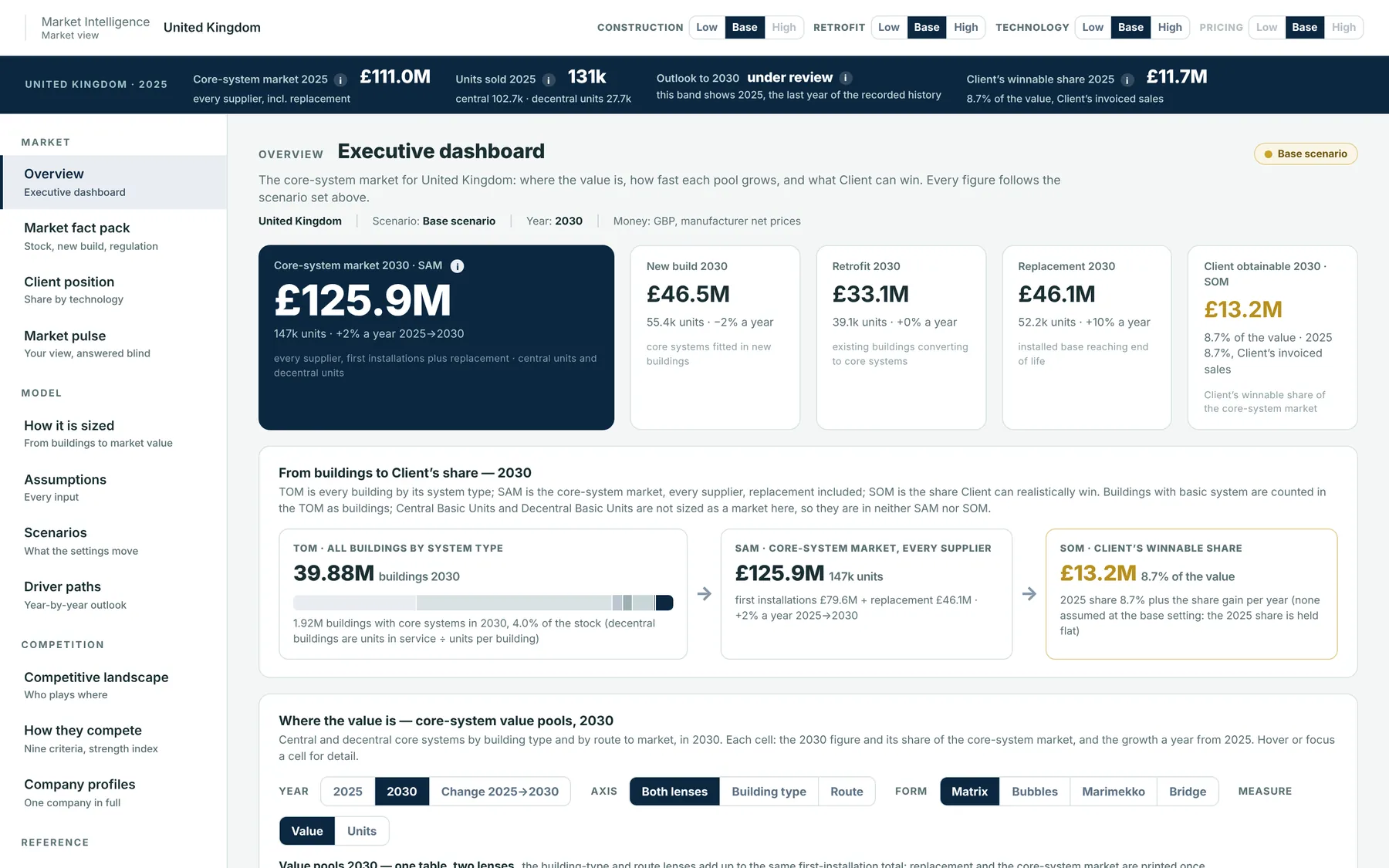
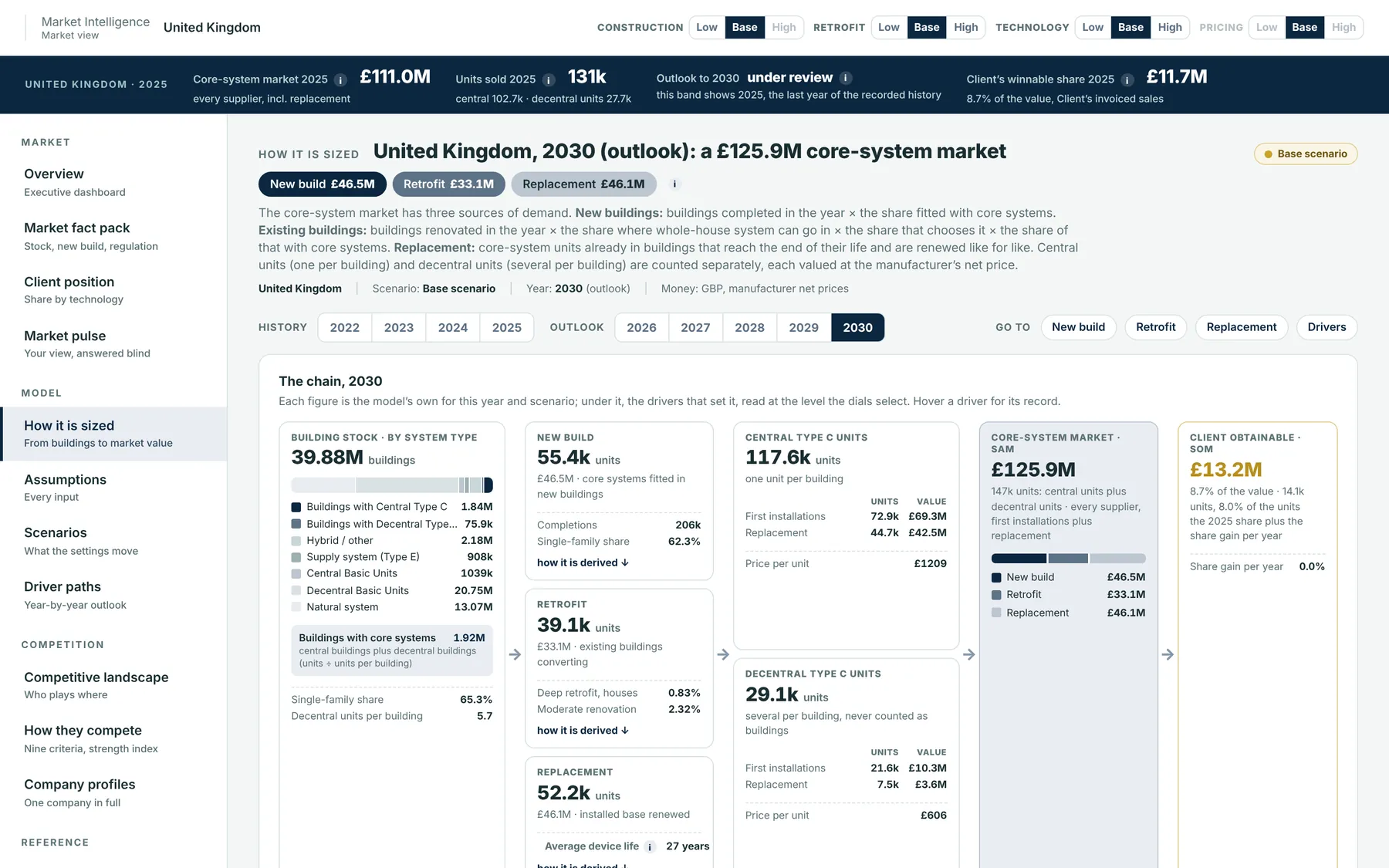
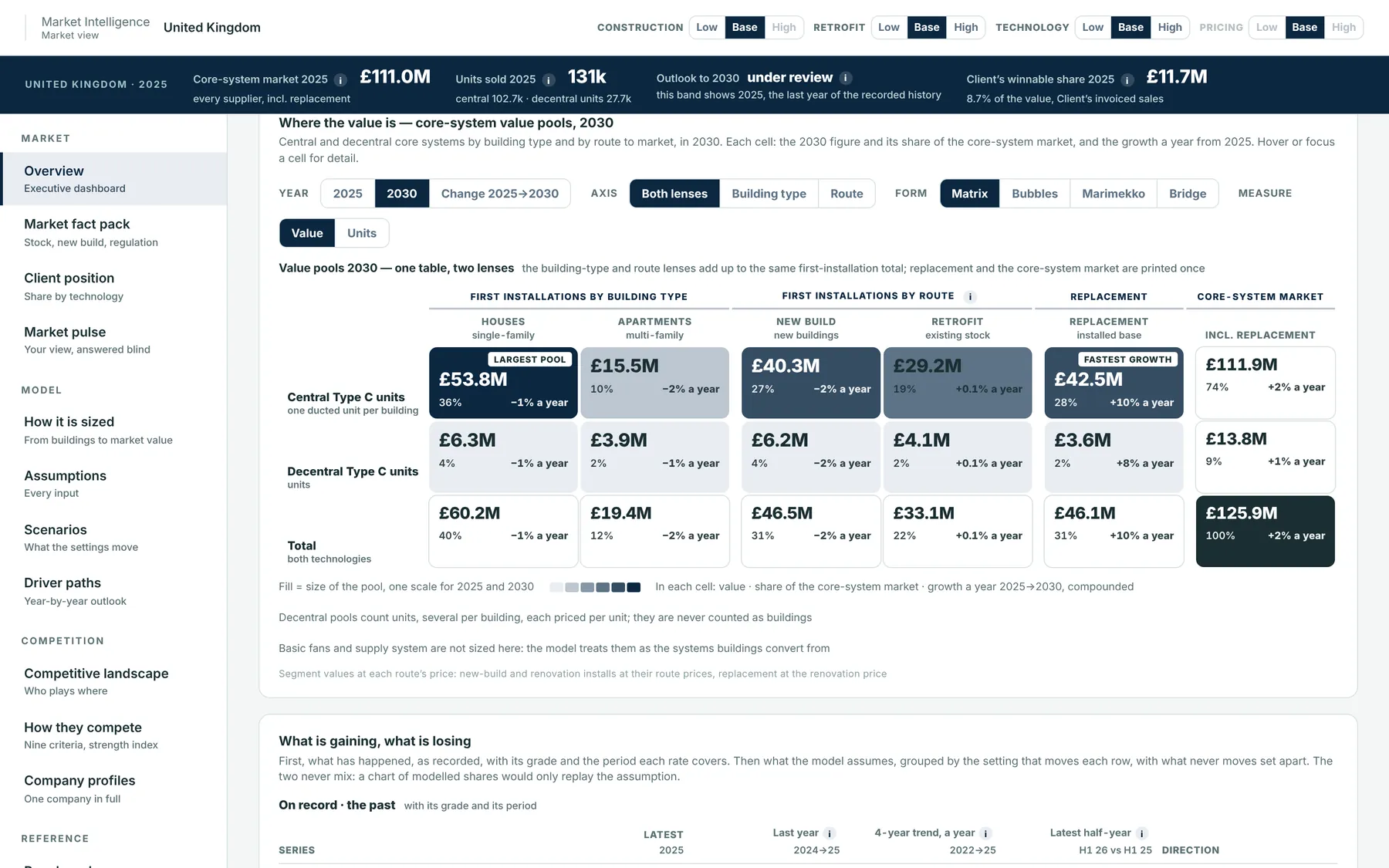
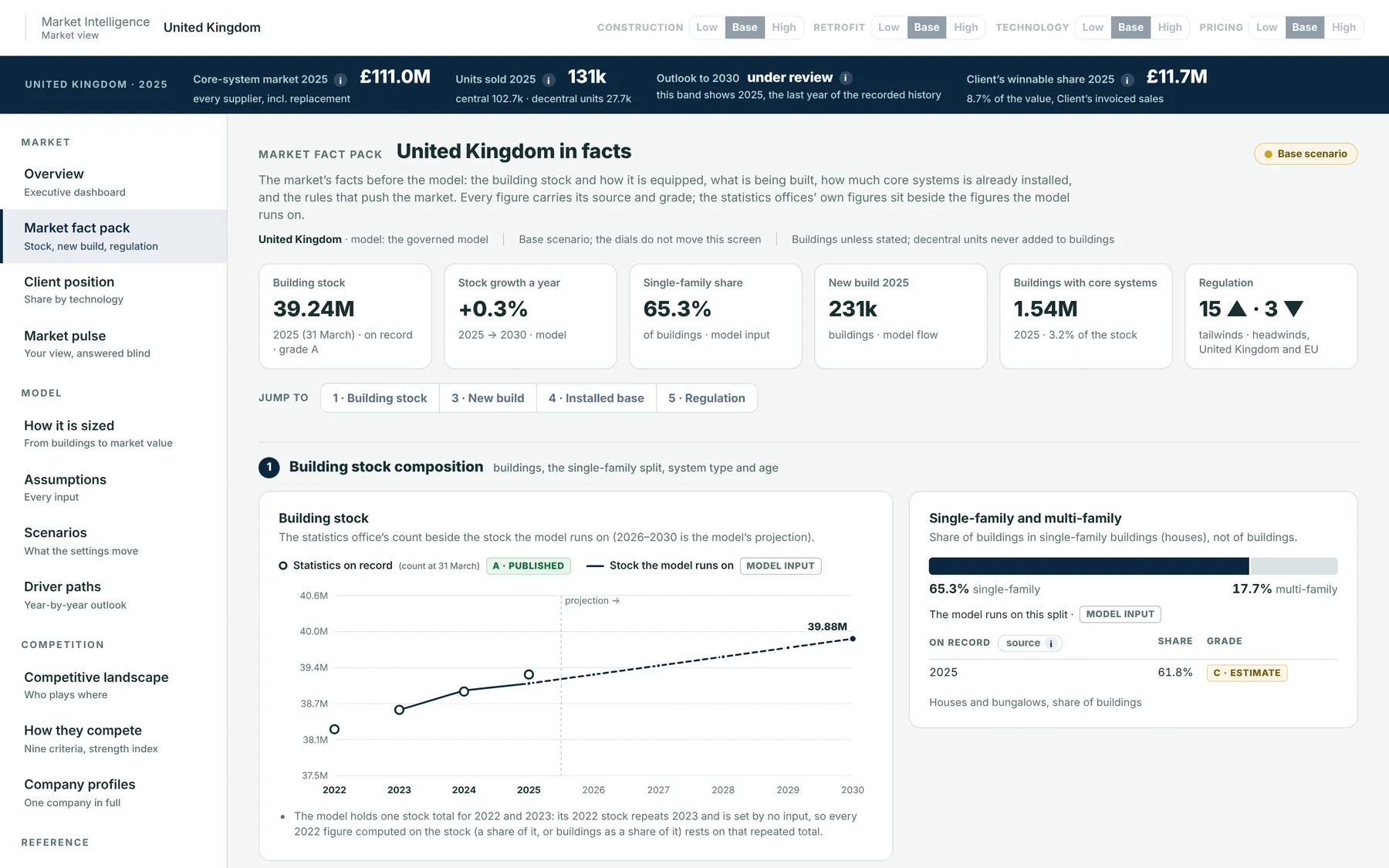
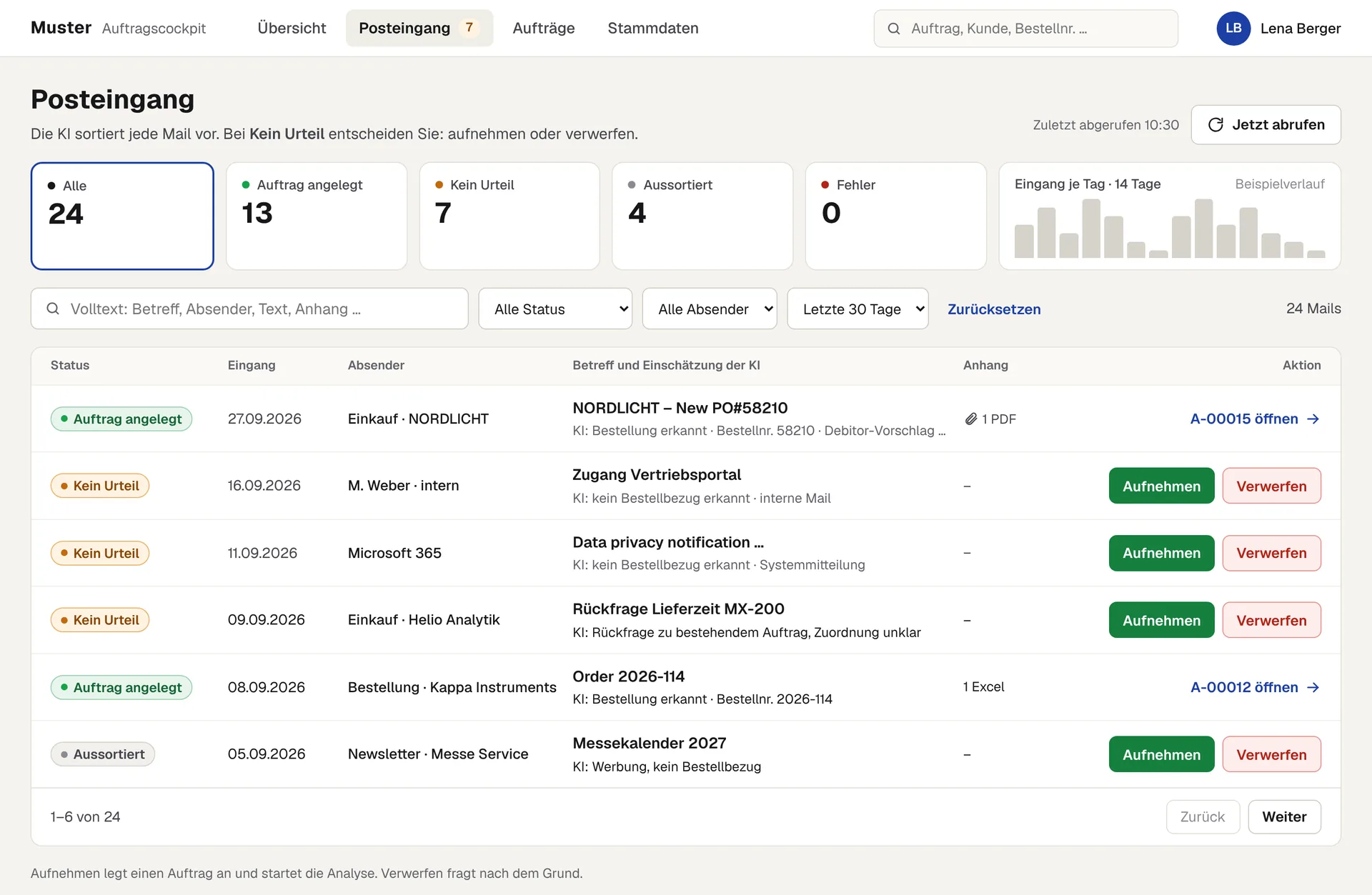
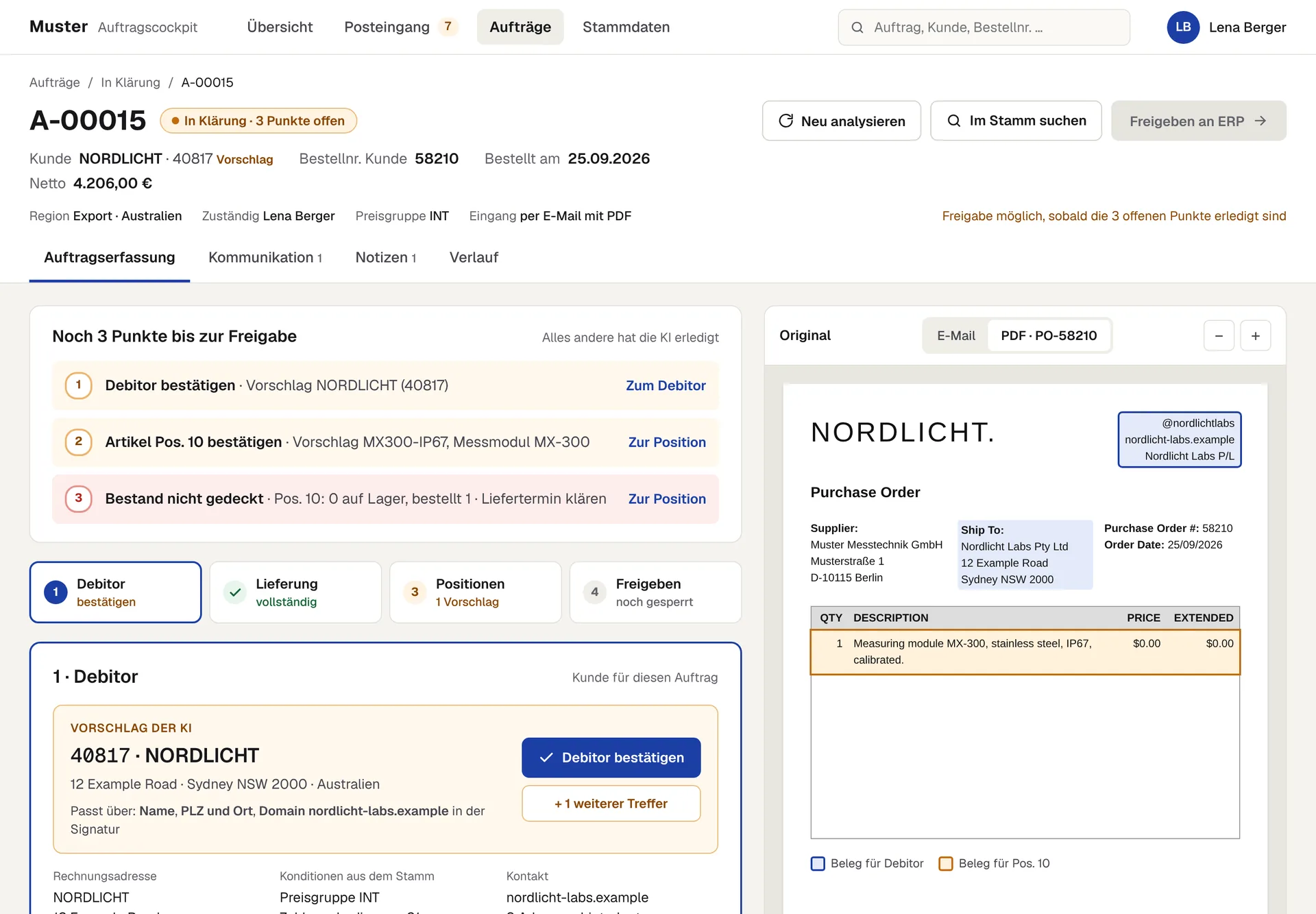
The handover includes
- Model, source register and manual
- Training: the team maintains it
- One person owns the tool
- Then further development or operation
Views from two tools (German interface); values, names and products altered.
A tool without enablement still goes stale. That is why the handover includes four things: the model with source register and manual, training after which the team maintains the tool itself, one person at the client who owns it, and a clear agreement on whether further development or operation follows. That way the knowledge stays in the company instead of leaving with the consulting team. What such tools look like is shown by our market model with cockpit and the example of AI order intake.
Will AI replace consultants? What stays human
AI is no silver bullet. A field experiment with employees of a management consultancy found that on tasks an AI handles well, participants with AI worked faster and better; on a task beyond its capabilities they reached the right answer less often than without AI (Dell’Acqua et al.). Hybrid teams therefore only work when it is clear what stays with people:
- The right question. People set the question, the bar and the kill criteria, not models.
- Conversations and trust. A person talks to the board, customers and experts, and consensus takes calendar time.
- Judgment. When evidence conflicts, a person weighs it and explains the choice.
- Accountability. "The AI said so" is no defence. Every recommendation has a name on it.
Possible today, or still science fiction?
| Building block | Today | What is still missing |
|---|---|---|
| AI teammate on the video call | Available in beta (Claude Meetings, on Google Meet at launch): notes, tasks and whiteboards live | Wide availability beyond Google Meet; clear rules for calls with outside guests |
| Client portal with live status | Can be built today, with company sign-in and roles per user group | Habit: many clients still expect decks by email |
| Shared project assistant | Technically possible today, limited to approved documents | Sign-off from IT and data protection, and in regulated firms from professional rules |
| Voice-memo feedback, results as an interactive page | Doable today with AI agents and version control | Ways of working: partners have to stop editing the document themselves |
| Pay for outcomes | Can be agreed today: a fixed price for a clearly defined result, blocks for tool and operation | KPIs that can be measured and attributed cleanly; procurement that thinks in consultant days |
| Tools and enablement instead of decks | Can be built today: prototypes and tools that stay after the project | One owner at the client and time for training |
How to spot a future-ready consultancy
If you hire a consultancy today, you can test its future in the proposal. Seven questions help:
- Which AI works on the team, and what is it allowed to do? A good answer names tools, tasks and limits.
- Which data may go into which tool? That is agreed before the start, not afterwards.
- Do we see the status live or only at steering committees? A project room with live status saves rounds of questions.
- Who checks AI output, and is there a name on it?
- What are we paying for: consultant days or a result? A good answer describes the result and its price, not just day rates.
- What stays after the project, and who can run it? A tool with a trained team, or a deck?
- Where does the time saved go? Into checking, interviews, tools or the price.
How we answer these questions for strategy work is covered in AI-aided strategy consulting: six fair doubts.
Frequently asked questions
What is the future of consulting?
Hybrid teams of experienced consultants and AI agents. The AI works visibly alongside people: on the video call, in a client portal that shows the project live, and as a shared project assistant for client and team. Deliverables become interactive tools rather than slide decks, and pricing moves towards outcomes rather than day rates. Judgment and accountability stay with people.
Will AI replace management consultants?
Not the consultants, but many of their tasks. AI agents increasingly take over research, first drafts, minutes and models. Framing the question, the conversations, weighing conflicting evidence and accountability for the recommendation stay human. There will be less demand for pure legwork and more for judgment and implementation.
What is a hybrid consulting team?
A project team of people and AI agents in which the agents own defined, visible tasks: research, drafts, models, minutes and cross-checks. People set the question, run the conversations, check the results and own the recommendation. The client can see what the AI does instead of it running invisibly in the background.
What is a client portal in consulting?
A secure project room where the client sees the current status: phase, hypotheses with evidence, sources, the business case and changes since the last visit. Unlike a deck it is always current, every number carries its source, and the client can change assumptions. Roles decide who sees what. After the project it stays in-house as a working tool.
Can an AI join client meetings?
Yes, if everyone knows and has agreed. The AI should be recognisable as a participant, recording and transcripts are agreed at project start, and anyone who doesn't want to be recorded isn't. Which tools are allowed is set by your AI policy and your data protection officer; this is not legal advice.
What does paying for outcomes mean in consulting?
Instead of consultant days times a day rate, the client pays a fixed price for a clearly defined result, such as a decision paper with a model. Building blocks for tool and operation come on top and, where impact can be measured cleanly, a share tied to an agreed KPI. The advantage for clients: the consultancy no longer earns more when things take longer.
What stays after a consulting project with AI?
Ideally a tool rather than a deck: a model with a cockpit, a portal or a prototype, plus a source register, a manual and training after which the team maintains it. One person at the client owns the tool, and it is agreed up front whether further development or operation follows.
Does AI make consulting cheaper?
Research and drafts get faster; conversations, checking and decisions hardly do. With us, AI support makes projects cheaper, but we do not promise a percentage. Ask any consultancy where the time saved goes: into checking, interviews, tools or the price.
Sources
- Rosenbaum, E. (2026, January 29). How CEOs bringing AI agents to work are preparing customers and employees. CNBC., CNBC (2026). Cited only for the figure given by McKinsey's global managing partner Bob Sternfels (CES, January 2026): about 25,000 personalised AI agents alongside roughly 40,000 employees. The firm's own statement, not an independent count.
- Anthropic. (2026, November 12). Introducing Claude Meetings, now in beta., Anthropic (2026). Vendor statement. Cited for Claude joining video calls as a visible participant that takes notes, answers questions and builds documents and whiteboards live; beta on Google Meet at launch, for Team and Enterprise plans.
- Dell’Acqua, F., McFowland III, E., Mollick, E., Lifshitz, H., Kellogg, K. C., Rajendran, S., Krayer, L., Candelon, F., & Lakhani, K. R. (2026). Navigating the jagged technological frontier: Field experimental evidence of the effects of artificial intelligence on knowledge worker productivity and quality. Organization Science, 37(2), 403–423., INFORMS (2026). Pre-registered field experiment with employees of a management consultancy; cited qualitatively only, for AI's 'jagged' capability frontier. Effect sizes deliberately not used.
- Boston Consulting Group. (2025, September 30). AI Leaders Outpace Laggards with Double the Revenue Growth and 40% More Cost Savings. Press release on the report "The Widening AI Value Gap: Build for the Future 2025"., Boston Consulting Group (2025). Global survey of 1,250 senior executives and AI decision makers. Cited for: 5% of companies qualify as "future-built", 60% report minimal revenue and cost gains from AI. Self-reported, categories set by BCG.